
Butterfly Nebula Mosaic
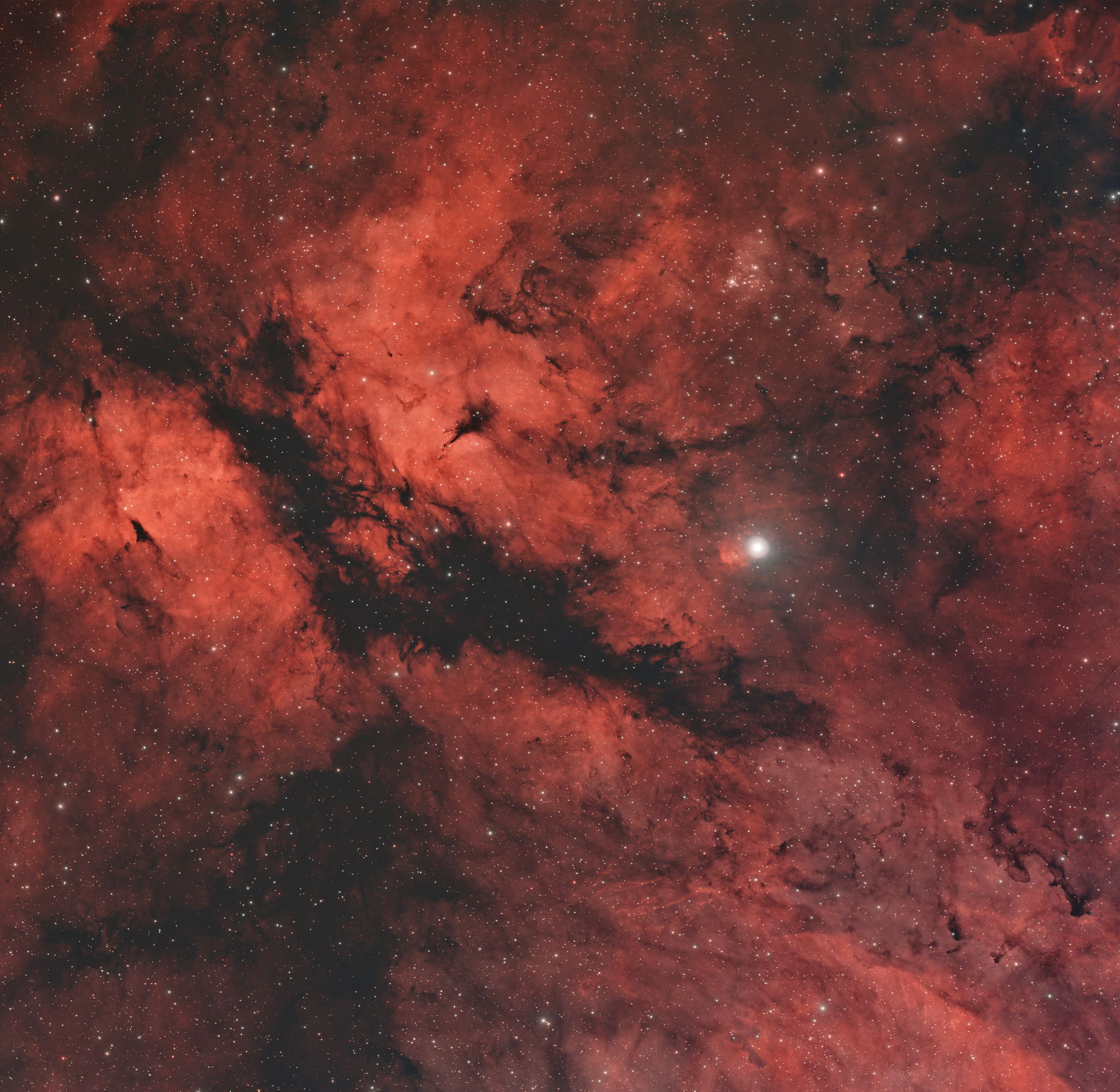
Photo by Matthew Ryno
Scope / Lens
Vixen AX103s Quad APO Refractor
Camera
ZWO ASI 2600mc
Exposure
92 hours of data (557x600?=92h 50) from 6 days integrated in this 3 panel mosaic at 600s with an Optolong L' Extreme dual narrowband filter.
Processing
I integrated the data in Astro Pixel Processor and completed post-processing in PixInsight.
Other
The mosaic full version of this preview photo above, revision B, is now available on my Astrobin page here: https://app.astrobin.com/i/sfxar6?r=B
Date
10/3/2025
Description
I'd welcome you to revisit the Butterfly Nebula with me again, this time with a 92-hours of data, on a mosaic of the region to start off 2026 with my largest astrophotography project.This is a mosaic of the Sadr Region (IC 1318) in the constellation Cygnus, centered on the supergiant star Sadr (Gamma Cygni), mostly using data acquired in my Cudahy backyard this fall, from September and October of 2025, with my Vixen AX103s refractor and a ZWO ASI 2600MC color astrophotography camera.
If you caught my first revision, then enjoy the expanded area now of bringing together more of the "Butterfly" Wings (IC 1318) surrounding Sadr, the supergiant star in the center, which are vast clouds of ionized hydrogen gas (H-alpha), glowing in deep, rich reds. These distinct "wings" of emission are separated by a dramatic, dark rift of obscuring dust. This is probably the most striking feature, as it is a chaotic river of dark dust cutting diagonally through the nebula, cataloged as LDN 889, or the body of the butterfly essentially. The more expansive amount of data I collected showcases some of the shockwaves as hydrogen gas ripples near the LBN 234 region in the strong cosmic wind of this giant star forming nebula. And like my first revision, you still see the star forming open cluster of NGC 6910, which is where new stars are forming as a result of all of this gas.
In my Astrobin page I also detail some processing changes I introduced in this revision vs revision A, which was processed differently using my 2025 methods. Notable changes to my usual routine for this year include using Generalized Hyperbolic Stretch vs Screen Transfer Function; and going with a starless removal after stretch vs only star masking, for enhanced nebulosity and star coloration with use of a dual narrowband Optolong l'Extreme filter. The Mosaic tiles themselves were also integrated into two tiled shots, then integrated once more all in Astro Pixel Processor, using mosaic mode and normalization, which did a great job registering such a large number of photos and normalizing them.
Secondary Object
NGC 6910 - Open
ID: 1639